
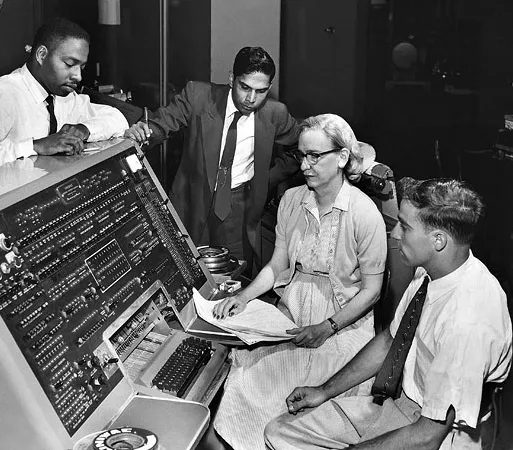
Photo: Smithsonian Institution, 1957, CC BY 2.0
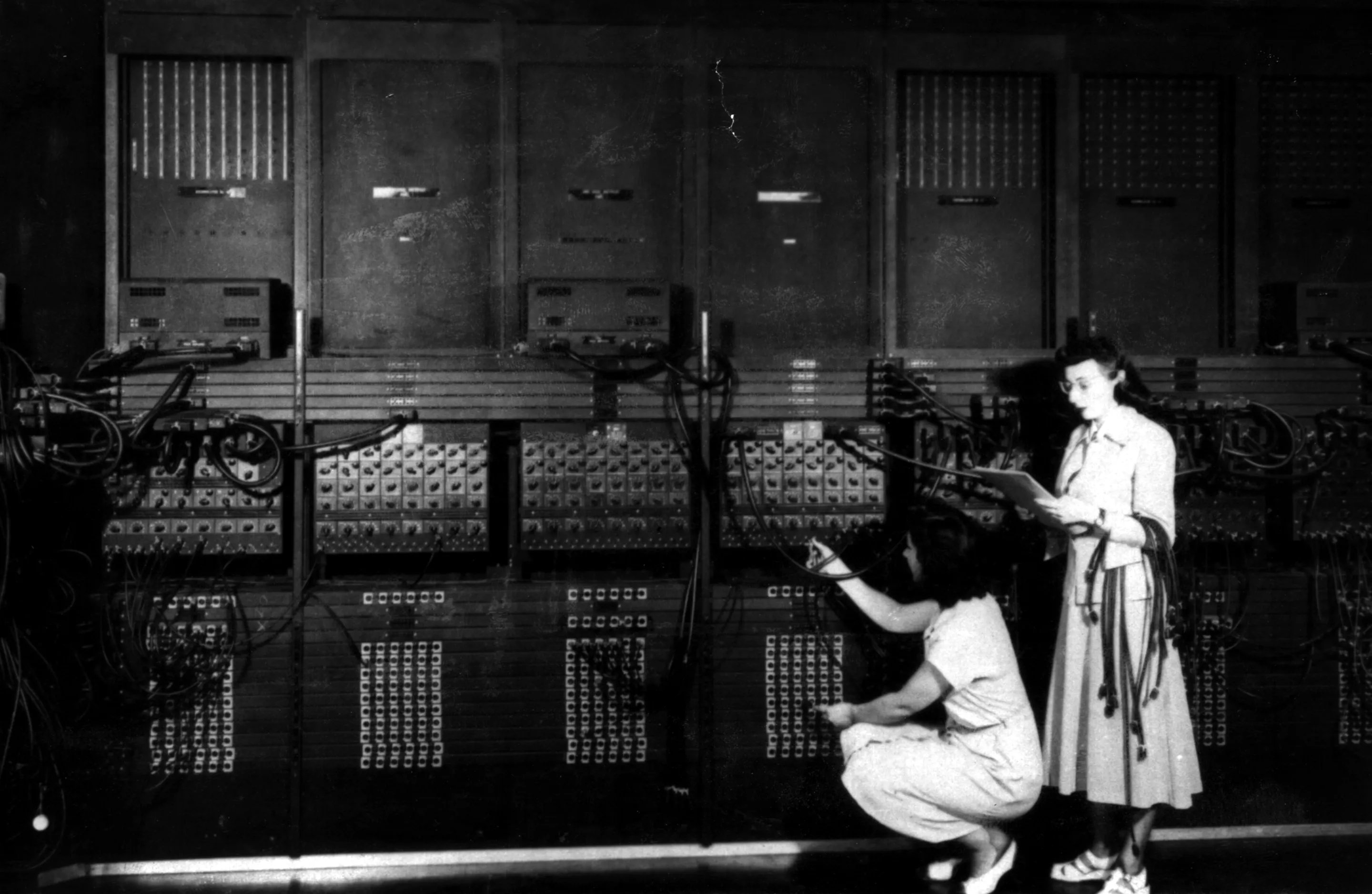
Harvard Mark I, 1944; A-0 compiler, 1952
Grace Hopper
Hopper’s formal education began at Vassar and culminated in a master’s and Ph.D. in mathematics from Yale, completed in 1934. She then taught mathematics at Vassar until World War II.
After Pearl Harbor, Grace applied to the Navy and was rejected for being too old, underweight, and a critical resource as a math professor. Hopper persisted, received a waiver, and was assigned to the Mark I, the first electromechanical computer in the U.S. It calculated rocket trajectories and anti-aircraft range tables.
Grace saw tedious, error-prone machine code as a blocker to scaling computer programming. In 1952 she developed the A-0, one of the first compilers. She then pushed for programs written in English, a concept deemed impossible. She dedicated three years to getting the idea accepted. Her team’s FLOW-MATIC became the first programming language to use English commands, directly shaping COBOL.
Her ideas about compilers and human-readable code underpin modern languages like Python and C++. I see a direct translation from her work to today’s natural-language AI compilers.
Grace was proudest of the young people she had trained, and I hope to leave a similar legacy.